
Industry Analysis of Kitchen Scales: Evolution from "Auxiliary Tool" to "Precision Cooking Data Entry Point"
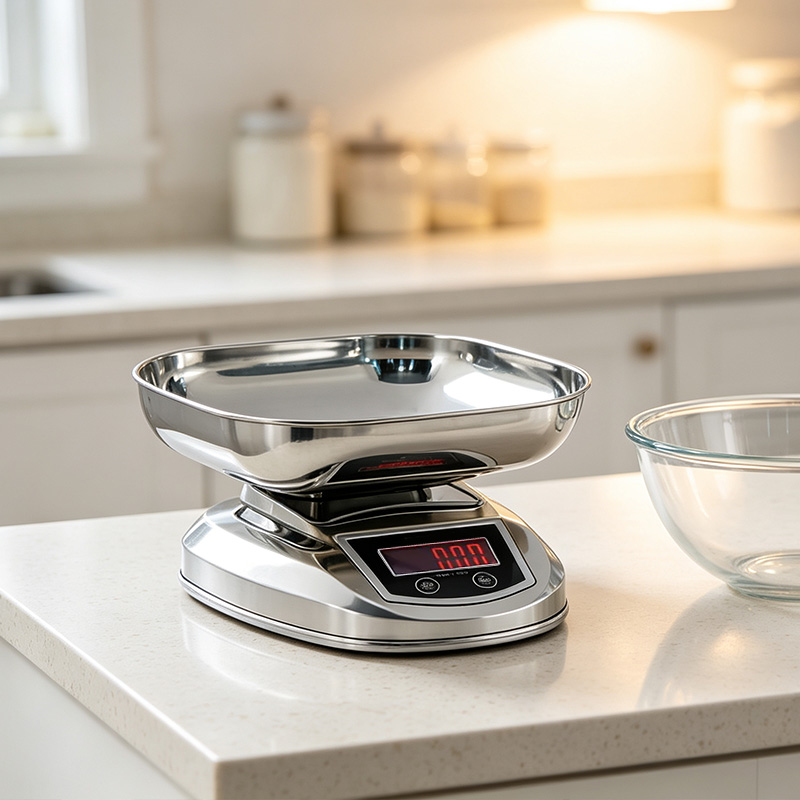
Kitchen scales, also known in the industry as baking scales, food scales, or nutrition scales, are precision weighing devices designed specifically for ingredient measurement and cooking ratios. Their core value is not simply "weighing" but solving a long-standing challenge in home cooking and professional baking: how to obtain accurate and reproducible ingredient ratio data without relying on volume estimation.
1. Product Essence: Defining the Boundary Between Kitchen Scales and Laboratory Balances
In industry practice, kitchen scales are often confused with laboratory balances, yet the two differ fundamentally in design logic, precision grades, and application scenarios.
Laboratory balances are essentially high-precision analytical instruments, typically offering resolution of 0.001g or even 0.0001g, equipped with draft shields, level indicators, and internal calibration systems. Their operating environment requires constant temperature and humidity, away from vibration sources, and operators need professional training. Laboratory balances pursue ultimate precision and traceability.
Kitchen scales, by contrast, are practical weighing devices for everyday cooking scenarios. Mainstream resolution ranges from 1g to 0.1g, with some high-end baking scales reaching 0.01g. What they pursue is not ultimate precision, but stable and reliable weighing performance in a kitchen environment (temperature fluctuations, moisture, grease, frequent movement). Waterproof platforms, tare functions, multi-unit switching, and compact design are the core competitiveness of kitchen scales.
This distinction determines the users: laboratory balances serve researchers and quality inspectors; kitchen scales serve home users, baking enthusiasts, and professional chefs.
2. Core Technical Features: Sensor Technology and Structural Design
The technical threshold of kitchen scales lies not in "weighing" itself, but in achieving a stable, fast, and durable weighing experience within limited cost and size constraints.
From a sensor technology perspective, mainstream kitchen scales use strain gauge load cells. The principle: when ingredients are placed on the platform, the metal elastic body inside the sensor undergoes minute deformation; the resistance strain gauges attached to it change resistance accordingly; the Wheatstone bridge converts the resistance change into a voltage signal; and finally the ADC chip converts it into a digital reading.
Sensor layout directly affects weighing consistency. Single-point sensors are simple and low-cost, suitable for small kitchen scales; four-point sensors distribute evenly for better consistency but at higher cost and structural complexity. Some high-end kitchen scales use silicon-based sensors, leveraging charge variation principles for better impact resistance and long-term stability.
Platform material and structural design are key differentiators. Tempered glass platforms are aesthetically pleasing and easy to clean but have limited impact resistance; stainless steel platforms are durable and corrosion-resistant but costlier; plastic platforms are lightweight and economical but prone to scratching. Some products feature removable platform designs for direct rinsing, meeting kitchen hygiene needs.
3. Industry Logic of Application Scenarios
The core application scenario of kitchen scales is not simply "weighing ingredients," but the rigid demand for digitizing cooking.
Home baking is the most representative scenario. Baking demands extremely high ratio precision; minor errors in flour, sugar, yeast, or water directly affect texture and success rate. Kitchen scales enable home users to accurately reproduce recipes, while the tare function allows smooth "add-as-you-weigh" operation.
Healthy eating and nutrition management is the fastest-growing scenario. As fitness enthusiasts and chronic disease patients pay more attention to protein, carbohydrate, and fat intake, kitchen scales have become the first stop for nutritional data collection. Some products now support connection with health apps, automatically converting ingredient weight into calorie and nutrient data.
Specialty coffee and pour-over scenarios place higher demands on kitchen scales. Coffee bean weighing requires 0.1g precision, along with fast response (to avoid coffee powder oxidation) and timer functions (to coordinate with pouring rhythm). This scenario has driven kitchen scales toward integrated "timer + weighing" development.
Commercial kitchens and food processing scenarios focus more on durability and compliance. Fully waterproof design, stainless steel housing, and NSF certification become key selection criteria. Some commercial kitchen scales also support check-weighing alarm functions for standardized portion control.
4. Industry Trend: From Standalone Device to Smart Kitchen Node
Kitchen scales are undergoing a transformation from "standalone weighing tools" to "smart kitchen data nodes."
Bluetooth and APP connectivity has become standard for mid-to-high-end kitchen scales. By transmitting weighing data in real time to a smartphone app via Bluetooth, users can view recipes, record history, calculate nutrition, and even achieve "weigh-and-record" seamless operation.
Deep integration with smart recipes is a deeper trend. Some brands have implemented "recipe-linked" functions: the app displays recipe steps, and the kitchen scale automatically zeroes and prompts the required amount for each step, allowing users to complete precise cooking by simply following along. This upgrades the kitchen scale from a "measuring tool" to a "cooking guidance device."
Nutritional dataization is another important direction. By connecting ingredient weight with nutritional databases, kitchen scales can directly output calories, protein, fat, and carbohydrates, becoming data collection endpoints in the health management loop. This has clear value for fitness enthusiasts, diabetic patients, and weight managers.
USB-C charging and eco-friendly design are also accelerating. Compared to traditional coin batteries, built-in lithium batteries with USB-C charging are more environmentally friendly and convenient, while supporting richer functions (such as backlit displays and Bluetooth transmission). Some brands are beginning to use recyclable materials and plastic-free packaging in response to sustainability concerns in European and American markets.
5. Industry Consensus on Selection and Usage
From industry practice, there are several key considerations in kitchen scale selection and usage.
Precision requirements determine sensor grade. 1g precision suffices for everyday home cooking; 0.1g is recommended for baking; 0.01g is needed for specialty coffee and micro-addition scenarios. Blindly pursuing high precision not only increases cost but may also cause unstable readings due to environmental interference.
Waterproof rating determines usage scenario. IPX4 handles daily splashes; IPX7 allows short-term immersion, suitable for direct rinsing; commercial kitchens should choose fully waterproof stainless steel models.
Platform size and container compatibility are often overlooked. An overly small platform prevents large bowls or baking pans from sitting stably, affecting accuracy. It is advisable to choose platform size based on the diameter of commonly used containers.
Unit switching and tare function are basic yet critical experience points. Support for multi-unit switching (g/kg/lb/oz/ml) and responsive tare function directly affect operational smoothness.
Calibration and maintenance determine long-term accuracy. Regular calibration with standard weights is recommended, avoiding overload, drops, and prolonged direct sunlight. Removable platform designs facilitate cleaning and extend service life.
The industry value of kitchen scales essentially lies in transforming the traditional cooking habit of "estimating by experience" into a quantifiable, reproducible, and integrable data stream. Against the backdrop of rising healthy eating awareness and the proliferation of smart kitchens, this seemingly simple category is becoming a key data entry point connecting cooking, nutrition, and health management.

join our newsletter
Stay connected with the latest weighing industry trends, expert insights, and exclusive OEM/ODM offers straight from our factory to your inbox.