
Industry Analysis of Chair Scales: Evolution from "Weighing Tool" to "Clinical Data Node"
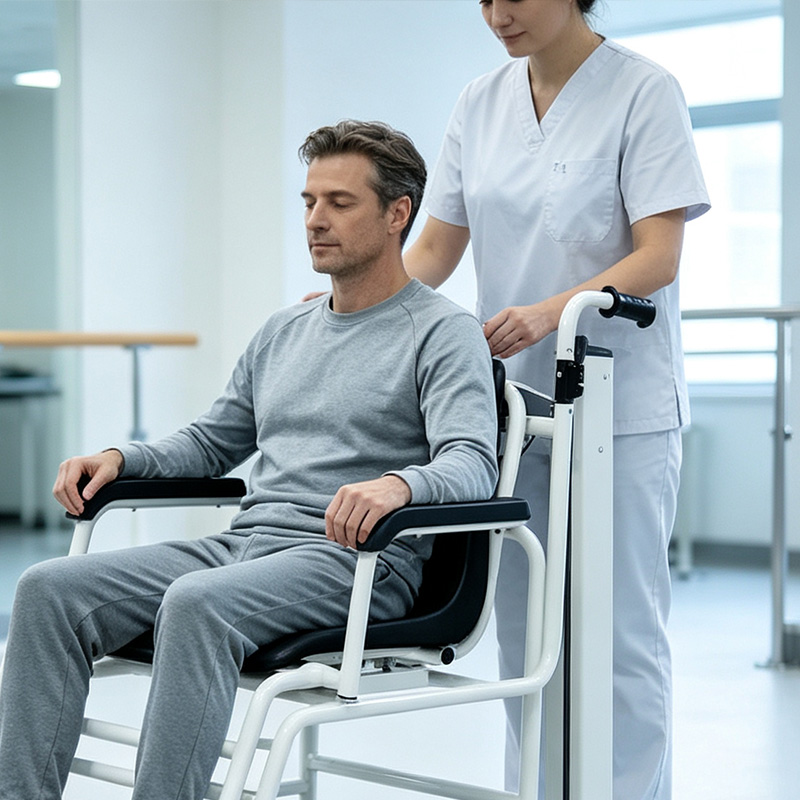
Chair scales, also known in the industry as seat scales, sitting body scales, or dialysis scales, are professional weighing devices specifically designed for individuals who cannot stand steadily. Their core value is not simply "weighing" but solving a long-standing clinical nursing challenge: how to obtain accurate and clinically meaningful weight data when patients cannot stand or have difficulty moving.
1. Product Essence: Defining the Boundary Between Chair Scales and Wheelchair Scales
In industry practice, chair scales are often confused with wheelchair scales, yet the two differ fundamentally in design logic and application scenarios.
Wheelchair scales are essentially low-profile weighing platforms (usually with a ramp or flush with the floor), allowing patients to be weighed while remaining in their own wheelchair. The workflow is "gross weight minus tare" — first measure the empty wheelchair weight, then weigh the patient in the wheelchair, and automatically deduct the wheelchair's own weight via the tare function.
Chair scales, by contrast, are standalone weighing devices with an integrated seat. Patients need to transfer from a bed or wheelchair onto this dedicated chair, and once seated, the net weight is read directly. The built-in sensors have already zeroed out the chair's own weight, eliminating the need for manual tare.
This distinction determines the target users: wheelchair scales suit patients who are fully wheelchair-dependent with high transfer risks; chair scales suit frail elderly or post-operative patients who can sit briefly but cannot stand steadily.
2. Core Technical Features: Sensor Layout and Safety Design
The technical threshold of chair scales lies not in "weighing" itself, but in maintaining measurement accuracy and safety during the dynamic process of a patient sitting down.
From a sensor technology perspective, mainstream chair scales use cantilever beam load cells, connecting the seat assembly to the base through a cantilever structure. The advantage of this design is that when a patient sits down, the minute deformation of the cantilever beam is precisely captured and converted into an electrical signal. Some products use silicon-based sensors that leverage charge variation principles to effectively absorb impact forces during weighing, preventing reading fluctuations or sensor damage caused by the instant of sitting down.
Safety design is the core differentiator between chair scales and ordinary electronic scales. Rear wheel locking is standard — ensuring the chair does not slide when the patient sits down or stands up. Foldable or swiveling armrests facilitate patient transfer from bed or wheelchair to the chair scale, while two grip styles (cross grip and vertical grip) offer caregivers more handling options.
3. Clinical Logic of Application Scenarios
The core application scenario of chair scales is not simply "weighing," but the rigid demand for clinical data collection.
Dialysis centers are the most representative scenario. Dialysis patients need precise weighing before and after each treatment to calculate fluid removal. Even minor errors in weight data directly affect ultrafiltration volume settings, which in turn impact treatment outcomes and patient safety. Chair scales enable this critical measurement without requiring the patient to stand, while built-in BMI calculation and tare functions reduce manual calculation errors.
Elderly care facilities and rehabilitation centers face the need for long-term weight monitoring. Weight changes in disabled elderly individuals are important indicators for assessing nutritional status, edema severity, and overall health trends. The mobility of chair scales (some models with casters, others foldable) allows flexible use across different rooms, balancing measurement accuracy with caregiving efficiency.
4. Industry Trend: From Standalone Device to Data Node
Chair scales are undergoing a transformation from "standalone weighing tools" to "clinical data nodes."
Standardization of data interfaces is the first signal. Modern chair scales commonly feature RS232 or USB ports, enabling direct connection to thermal printers or upload to hospital HIS systems. Patient weight data no longer requires manual transcription but automatically enters electronic health records, reducing transcription errors and improving data traceability.
Integration with electronic medical record systems is a deeper trend. Some high-end models now support automatic data upload to EMR systems, making weight data part of clinical decision support systems. This means chair scales are no longer isolated measurement devices but data collection endpoints within the patient's full-cycle health management chain.
Functional integration is also accelerating. Some chair scales now incorporate auxiliary systems such as blood pressure measurement and pulse monitoring, with readings displayed and stored alongside weight data. This meets the clinical demand for "one operation, multiple collections," particularly suited to geriatrics and chronic disease management.
5. Industry Consensus on Selection and Usage
From industry practice, there are several key considerations in chair scale selection and usage.
Transfer capability assessment takes priority over equipment parameter selection. If a patient cannot transfer from a wheelchair at all, chair scales are not applicable — a wheelchair scale should be chosen. If the patient can sit briefly with assistance, a chair scale is the better solution, as its measurement process is simpler (no need to deduct wheelchair weight) and the patient's seated posture is more stable.
Environmental adaptability cannot be overlooked. In nursing homes and home care settings, the folding design and caster configuration of chair scales directly affect usage frequency. A chair scale requiring two people to move is often left idle in space-limited care environments.
Standardization of tare management is key to ensuring data accuracy. Whether chair scales or wheelchair scales, caregivers need to establish standard operating procedures: confirm the scale is zeroed, ensure the patient's full weight is entirely borne by the seat or platform, and prevent the patient's hands or feet from touching the floor or armrests.
The industry value of chair scales essentially lies in transforming the clinical constraint of "inability to stand" into a quantifiable, traceable, and integrable data stream. Against the backdrop of accelerating aging populations and refined chronic disease management, this seemingly niche category is becoming one of the most certain growth tracks in the medical weighing field.

join our newsletter
Stay connected with the latest weighing industry trends, expert insights, and exclusive OEM/ODM offers straight from our factory to your inbox.